
Operating in a nautical netherworld via opaque ownership and location cloaking methods, Russia’s antiquated shadow fleet has simultaneously evaded sanctions to support the nation’s wartime economy and provided a platform for Moscow’s hybrid warfare against Western states since 2022.[1][2][3][4] The Kremlin-directed fleet has resurrected Soviet-era tactics, techniques, and procedures (TTPs) to sow socioeconomic discord and normalize irregular warfare via a new form of below-kinetic gray zone tactics.[5] In skirting NATO’s Article 5 and obfuscating responsibility, Russia strategically positions itself as a cloaked instigator of hybrid warfare.
In 2024–2026, Europe cracked down on Russia’s shadow fleet, which caused the Kremlin to further entrench its gray-zone tactics of alternating transit routes, reflagging vessels, and staffing ships with security personnel.[7][8][9][10] Hybridity permeates Russia’s shadow fleet: it is an amalgamation of commercial and military operations, Soviet strategies paired with twenty-first century technology, and actions conducted via ambiguous attributions.
| Alternate Names | Dark fleet, Ghost ships |
| Size | ~3,200 vessels |
| Average Age | 16-20 years |
| Operating Areas | Baltic Sea Black Sea English Channel Ireland’s Exclusive Economic Zone Mediterranean Sea Murmansk Northern Sea Route |
| Commodities | Agricultural products Coal Dual-purpose goods Fertilizers Liquefied Natural Gas Oil and Petroleum Weapons |
Incentives, Adaptations, and Tactics
Since its 2022 invasion of Ukraine, Russia has operated a shadow-fleet network of vessels and intermediaries to circumvent Western sanctions and trade military and commercial commodities with key allies such as China, Iran, and North Korea. As of 2026, profits from sanctioned cargo transports continue to sustain Russia’s war against Ukraine. Much of the fleet consists of aging tankers with limited commercial value that operate outside traditional shipping and insurance systems; such vessels can be bought cheaply, are easily replaced, and require minimal technical expertise to operate. Despite its dilapidated condition, the fleet conveyed 65–70% of the country’s nautical oil exports from 2022–2025 while routinely violating maritime regulations by:[18][19][20][21][22][23][24]
- Operating without active automatic identification system (AIS) transmitters
- Manipulating their global navigation satellite system (GNSS) positioning data
- Disguising ownership through shell companies and frequent name and flag registry changes
- Concealing cargo by enlisting secondary vessels to dock at smaller ports to offload cargo, a practice known as ship-to-ship transfers (STS)
Moscow’s maritime posturing relies on three Cold War-era TTPs that use deception, misdirection, and manipulation to obfuscate attribution and enhance plausible deniability:
| Maskirovka | Engaging in deceptive tactics in an effort to afford deniability; Russian for masking |
| Reflexive Control | Using manipulation and fear of provocation to bolster plausible deniability |
| Hybrid Asymmetry | Exploiting regulatory gaps, engaging in intelligence, surveillance, and reconnaissance (ISR) activities, and propagating disinformation |
The doctrine of maskirovka—Russian for military deception—focuses on masking vessels’ movements, ownership, and conveyed cargo. Russian shadow-fleet vessels have increasingly sailed under false flags or frequently changed flag registries—also known as “flag hopping”—so crews can claim sovereign protection; the number of falsely flagged Russian ships rose by 500% from December 2024–September 2025.[25][26] Additional maskirovka tactics include turning off AIS transmitters, falsifying port documentation, spoofing locations, and obscuring ownership records.[27][28][29]
Reflexive control involves using methods that spark uncertainty regarding the vessels’ sovereignty, consequently complicating how countries might respond without provoking an international incident.[30] By operating below NATO’s Article 5, Russia gauges Europe’s response, evades culpability, and evaluates loopholes within maritime regulations such as the United Nations Convention on the Law of the Sea (UNCLOS).[31][32] According to UNCLOS, flag states have primary jurisdiction over their vessels and are held criminally liable—stipulations Moscow exploits with its reflagged ships.[33]
In using hybrid asymmetry tactics, Moscow leverages civilian cover and unconventional tools to exploit adversaries’ regulatory and security gaps. The commercial shadow fleet ships give Moscow excellent cover to not only orchestrate sanctions evasions and illicit trade but also to conduct sabotage, intelligence, and surveillance operations. According to 2026 United24 Media reporting, a network of security services, defense agencies, centralized banks, and trusted pro-Kremlin intermediaries have financed the shadow fleet as part of “a covert extension of Moscow’s military and intelligence operations.”[34]
These three dual-purpose TTPs underscore Moscow’s goals: profiteering whilst testing Western resolve. Demonstrating restraint while capitalizing on opportunity, the Kremlin denies involvement in its fleet’s illicit activities while Europe scrambles to ascertain the best course of action in offsetting such operations.
Cold War-Era TTPs Meet New Gray Zone Tactics
While initially a primarily economic tool to circumvent sanctions, Russia’s shadow fleet has been increasingly militarized and integrated into state security structures.[35] Following Europe’s crackdown on shadow vessels starting in 2024, Russia began adding “supernumeraries” or “technicians” to its ship manifests in mid-2025—particularly for ships transiting the Baltic Sea. These non-traditional staff include: private security personnel, suspected Wagner Group mercenaries, military troops, ministry officials, and Main Intelligence Directorate (GRU) personnel.[36][37] A joint investigation by the Organized Crime and Corruption Reporting Project, iStories, Delfi, and Helsingin Sanomat found 13 of the 17 crew aboard 20 trips made by sanctioned Russian tankers did not possess maritime credentials and had state security or private military company affiliations. Former Wagner Group mercenaries and GRU officials, including from the special forces Spetsnaz Brigade, were aboard Kira K in December 2025, while Ministry of Defense “technicians” were aboard Lebre.[38] These personnel likely surveil the ships’ Russian crew while also overseeing hybrid operations, thereby further entrenching the fleet in Moscow’s reflexive control statecraft.
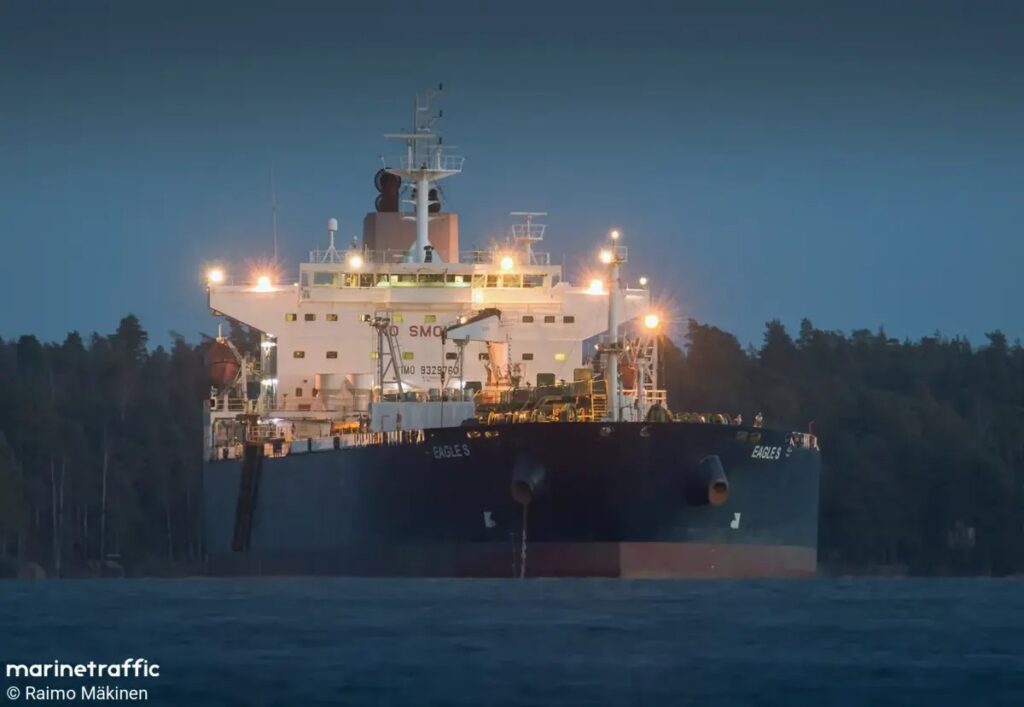
Russia has also equipped some merchant vessels with listening and recording devices to surveil NATO planes and ships. Finnish authorities discovered such devices aboard the Russian tankers Eagle S and Swiftsea Rider during their 2024 seizures.[39] Finnish officials also accused the Eagle S of intentionally severing four telecommunication cables and the Estonia-Finland Estlink 2 undersea power cable in December 2024, which caused an estimated $70 million in damages. However, Moscow’s maskirovka tactics proved successful: a Finnish court dismissed the case over jurisdictional complications, lack of evidence, and lack of intent, noting the crew must be tried by their home nations or St. Vincent and Grenadines—the flag under which Eagle S sailed at the time of seizure.[40][41][42][43][44]
Sabotaging undersea infrastructure—a form of reflexive control—is likely an attempt to disrupt European networks in critical nautical thoroughfares like the Gulf of Finland and Barents Sea.[46][47] The shadow fleet’s economic impact is therefore twofold: funding Moscow’s wartime economy by conveying sanctioned cargo while saddling Europe with expensive undersea repairs. According to NATO Allied Maritime Command Vice Admiral Didier Maleterre in June 2026, “All of our economy under the sea is under threat.” A reported likely participant of these sabotage incidents is Russia’s Main Directorate of Deep-Sea Research (GUGI)—a classified Ministry of Defense directorate tasked with overseeing naval intelligence vessels, acts of underwater sabotage, and seabed warfare.[48][49]
Russia’s dark fleet activities, however, do not pertain solely to the seas. From August 2024–February 2026, AIS data and synthetic aperture radar satellite imagery triangulated Russian shadow ships’ geolocations and placed them in close proximity to 144 nighttime drone incursions across 13 European nations, per a 2026 International Institute for Strategic Studies investigation. Reportedly used as launch, recovery, and network relay platforms, Russian vessels including the Arctica, Boracay, Hav Dolphin, Jin Hui, and Vladimir Rusanov were strategically positioned near multiple locations where such UAV overflights took place, including at Copenhagen Airport; Denmark’s Skrydstrup Air Base; France’s Ile Longue nuclear-submarine base; Sweden’s Koge Port; and UK Air Bases Fairford, Feltwell, Lakenheath, and Mildenhall. The flights allowed Moscow to surveil strategic command, nuclear, and air defense infrastructure, identify radar blind spots, and map sites that were providing Ukraine with logistical support.[50]
Although officials in Belgium, Germany, and Sweden have accused Russia of UAV incursions, proof of Moscow’s explicit involvement remains largely elusive.[51] Only one Russian ship, the military intelligence vessel Zhigulevsk, was directly implicated after launching a drone that violated Swedish airspace in February 2026, and confirmed Russian drones were used in only three of the 61 incursions that took place from September–November 2025.[52][53] However, European authorities and security analysts assert Russia and its shadow fleet are likely behind the incursions, citing key parallels with Moscow’s playbook: the surveillance of critical European infrastructure, an ongoing UAV campaign to test NATO’s resolve, and inexpensive military-grade drones flying in formation.[54][55][56] French and German officials consequently seized two shadow vessels in September and October 2025 under suspicion of launching drones—the Scanlark and Boracay—the latter of which had intelligence personnel from the FSB-affiliated Moran Security Group aboard.[57][58][59][60]
The likelihood that Russia’s shadow fleet has participated in the recent drone incursions is bolstered by Moscow’s adherence to the maskirovka doctrine, reflexive control, and hybrid asymmetry. The clandestine commercial vessels provide cover for Russia to launch ISR missions with ambiguous attribution. The incursions disrupt commercial activities at strategic airports, resulting in interceptions and airport closures that cost Western states millions of Euros.[61][62] They test NATO’s responsiveness and resolve, identify vulnerabilities, pose military security risks, stoke fears of provocation, and normalize airspace violations at a frequency and level to which Western nations scramble to respond.[63] All of this occurs below the threshold of kinetic war—the shadow fleet’s underlying methodology.
Implications of Russia’s Nautical Playbook
The shadow fleet’s resurrection of Soviet-era TTPs demonstrates Moscow’s ingrained dedication to non-linear hybrid warfare adaptations. Saddled with sanctions, the Kremlin pivoted to increasingly rely on its inexpensive, illicit vessels to instigate asymmetric costs against Western states. From 2022–March 2026, Russian shadow vessels were involved in at least 25 reported incidents—including collisions, explosions, and sabotage—which, due to the ships’ insufficient insurance and maskirovka methods, placed the financial burden of repairs on affected littoral nations. The antiquated vessels also pose environmental risks: if even one tanker spilled, it could result in estimated clean-up costs of $859 million for Europe.[64] Meanwhile, the Russian tankers convey 3.7 million oil barrels daily and generate $87–100 billion in annual revenue—profits used to keep Moscow’s wartime economy afloat.[65][66][67]
The shadow fleet’s cost-effectiveness, coupled with its successful evolution into a devoted instigator of below-kinetic twenty-first century warfare, indicate the Kremlin will continually adapt the vessels to suit its economic and geopolitical objectives. After all, the implementation of Soviet TTPs affords Moscow the means by which the fleet can operate below NATO’s collective security thresholds while obfuscating attribution. The Kremlin can subsequently label Western states as the aggressors should a situation escalate, as Russia has done with the Ukraine conflict.
Russia will undoubtedly continue its modus operandi of applying Cold War-era tactics to the latest technological advancements. Future developments will likely include shadow vessels serving as hubs for unmanned underwater vehicle (UUV) operations, functioning as reference nodes for conducting electronic warfare and GNSS interference, and providing reinforcements for the Kaliningrad exclave and bases situated near Finland and the Baltics. A masked provocateur, the dark fleet embodies the direction Moscow’s hybrid warfare will continue to take.
- Kozyreva, Tanya. “Exclusive: We Discovered What’s Going On Inside Russia’s Shadow Fleet.” Kyiv Independent. April 1, 2026. https://kyivindependent.com/exclusive-inside-russias-shadow-fleet/ ↩︎
- Bassoli, Anna Matilde, and Emma Isabella Sage. “Old Ships, Modern Menace: How to Tackle the World’s Shadow Fleets.” Royal United Services Institute. January 28, 2026. https://www.rusi.org/explore-our-research/publications/commentary/old-ships-modern-menace-how-tackle-worlds-shadow-fleets ↩︎
- Janjalia, George. “Russia’s Shadow Fleet: The Dangerous Tanker Network Threatening Global Waters.” Irregular Warfare Initiative. August 5, 2025. https://www.irregularwarfare.org/russias-shadow-fleet-floating-hazard-irregular-warfare/ ↩︎
- Stupnicki, Witold. “Russia’s Shadow Fleet Presents a Sustained Hybrid War Threat at Sea.” Armed Conflict Location and Event Data. May 22, 2026. https://acleddata.com/report/russias-shadow-fleet-presents-sustained-hybrid-war-threat-sea ↩︎
- Abbott, Catherine Marie. “Russia’s Drone Machinations: Reflexive Control and Cognitive Warfare in the Maritime Domain.” Center for Maritime Strategy. July 2, 2026. https://centerformaritimestrategy.org/publications/russias-drone-machinations-reflexive-control-and-cognitive-warfare-in-the-maritime-domain/ ↩︎
- “Siren II.” War Sanctions. June 2, 2026. https://war-sanctions.gur.gov.ua/en/transport/shadow-fleet/1355 ↩︎
- Holmes, Richard. “Putin’s Shadow Fleet Tankers Veer Away from Channel After UK Vows to Seize Them.” i Paper. March 27, 2026. https://inews.co.uk/news/putins-shadow-fleet-tankers-veer-away-channel-uk-4318694 ↩︎
- “Russian Dark Fleet Tankers Seek Shelter Along Turkish Coast from Ukrainian Drone Strikes.” Windward. December 25, 2025. https://windward.ai/blog/russian-dark-fleet-tankers-seek-shelter-along-turkish-coast-from-ukrainian-drone-strikes ↩︎
- Janjalia, George. “Russia’s Shadow Fleet: The Dangerous Tanker Network Threatening Global Waters.” ↩︎
- Roonemaa, Holger, et al. “From Wagner to GRU, Russian Military Men Are Manning Moscow’s Shadow Fleet.” Organized Crime and Corruption Reporting Project. March 10, 2026. https://www.occrp.org/en/investigation/from-wagner-to-gru-russian-military-men-are-manning-moscows-shadow-fleet ↩︎
- Kozyreva, Tanya. “Exclusive: We Discovered What’s Going On Inside Russia’s Shadow Fleet.” ↩︎
- “Shadow Fleet Gets a Naval Bodyguard as Russia Tests UK Resolve in the Channel.” Navy Lookout. April 25, 2026. https://www.navylookout.com/shadow-fleet-gets-a-naval-bodyguard-as-russia-tests-uk-resolve-in-the-channel ↩︎
- “Northern Sea Route Increasingly Used by Russia’s Shadow Fleet.” The Watch. March 12, 2026. https://thewatch-journal.com/2026/01/30/northern-sea-route-increasingly-used-by-russias-shadow-fleet ↩︎
- Mooney, John. “Russia Shipped Crude Oil Worth €3.7Bn Through Irish Waters.” The Times. February 7, 2026. https://www.thetimes.com/world/ireland-world/article/russia-oil-3bn-shadow-fleet-irish-waters-2ccj96xtf ↩︎
- Fox, Jackie. “Data Flags Hundreds of Russian ‘Shadow Fleet’ Visits to Irish EEZ.” RTE News. July 25, 2025. https://www.rte.ie/news/primetime/2025/0724/1525050-shadow-fleet-irish-eez ↩︎
- Vakhrusheva, Ksenia. “The Northern Shadow Route – 100 Sanctioned Ships Sailed Along Russia’s Arctic Coast in 2025.” Bellona Environmental Transparency Center. December 15, 2025. https://etc.bellona.org/2025/12/15/nsr-2025 ↩︎
- Menjon, Daniel Martin. “Russia’s Shadow Fleet: A Maritime Network to Evade Sanctions, Its Operations, Destinations, and Comparison with the Fleets of Iran and Venezuela.” Hermes Kalamos. August 12, 2025. https://www.hermes-kalamos.eu/russias-shadow-fleet-a-maritime-network-to-evade-sanctions-its-operations-destinations-and-comparison-with-the-fleets-of-iran-and-venezuela ↩︎
- Abbott, Catherine Marie. “NATO Collective Legal Interpretations: Strengthening Alliance Deterrence and Protecting Baltic Undersea Assets Against Grey-Zone Threats.” Center for Maritime Security. May 26, 2026. https://centerformaritimestrategy.org/publications/nato-collective-legal-interpretations-strengthening-alliance-deterrence-and-protecting-baltic-undersea-assets-against-grey-zone-threats ↩︎
- Janjalia, George. “Russia’s Shadow Fleet: The Dangerous Tanker Network Threatening Global Waters.” ↩︎
- Bassoli et al. “Old Ships, Modern Menace: How to Tackle the World’s Shadow Fleets.” ↩︎
- Braw, Elisabeth. “Russia’s Growing Dark Fleet: Risks for the Global Maritime Order.” Atlantic Council. January 11, 2024. https://www.atlanticcouncil.org/in-depth-research-reports/issue-brief/russias-growing-dark-fleet-risks-for-the-global-maritime-order/#shadow-fleet-incidents-and-accidents ↩︎
- Menjon, Daniel Martin. “Russia’s Shadow Fleet: A Maritime Network to Evade Sanctions, Its Operations, Destinations, and Comparison with the Fleets of Iran and Venezuela.” ↩︎
- Braw, Elisabeth. “The Caspian Sea Is a Sanctions-Busting Paradise.” Foreign Policy. August 14, 2023. https://foreignpolicy.com/2023/08/14/russia-iran-caspian-sea-sanctions-busting-paradise ↩︎
- Pili, Giangiuseppe, Alessio Armenzoni, and Gary Kessler. “Russia’s Shadow Fleet Tactics Exposed.” Maritime Executive. June 23, 2024. https://maritime-executive.com/editorials/russia-s-shadow-fleet-tactics-exposed ↩︎
- “Flags of Inconvenience: 113 Vessels Flying a False Flag Transported EUR 4.7 Bn Russian Oil in First Three Quarters of 2025.” Centre for Research on Energy and Clean Air. November 27, 2025. https://energyandcleanair.org/publication/flags-of-inconvenience-113-vessels-flying-a-false-flag-transported-eur-4-7-bn-russian-oil-in-first-three-quarters-of-2025 ↩︎
- Edwards, Charlie. “Europe’s Coastal States Tighten Enforcement on Russia’s Shadow Fleet.” International Institute for Strategic Studies. March 9, 2026. https://www.iiss.org/online-analysis/online-analysis/2026/03/europes-coastal-states-tighten-enforcement-on-russias-shadow-fleet ↩︎
- “Secret Sailings: Oil Tankers Turn Off Tracking Between Russian and Georgian Ports.” Organized Crime and Corruption Reporting Project. January 28, 2026. https://www.occrp.org/en/news/secret-sailings-oil-tankers-turn-off-tracking-between-russian-and-georgian-ports ↩︎
- Braw, Elisabeth. “Russia’s Growing Dark Fleet: Risks for the Global Maritime Order.” ↩︎
- Pili et al. “Russia’s Shadow Fleet Tactics Exposed.” ↩︎
- Abbott, Catherine Marie. “Russia’s Drone Machinations: Reflexive Control and Cognitive Warfare in the Maritime Domain.” ↩︎
- Pawlak, Julian. “Measures Against the ‘Russian Shadow Fleet.’” Stiftung Wissenschaft und Politik. May 2026. https://www.swp-berlin.org/publikation/measures-against-the-russian-shadow-fleet ↩︎
- Abbott, Catherine Marie. “Russia’s Drone Machinations: Reflexive Control and Cognitive Warfare in the Maritime Domain.” ↩︎
- Rolander, Andrew. “Irregular Warfare at Sea: How Russia’s Shadow Fleet Undermines Maritime Security.” Small Wars Journal. December 11, 2025. https://smallwarsjournal.com/2025/12/11/irregular-warfare-at-sea ↩︎
- Daly, Jess. “Not an Army, but Close—Russia’s Shadow Fleet Is a Covert Military Asset.” United24 Media. April 16, 2026. https://united24media.com/world/not-an-army-but-close-russias-shadow-fleet-is-a-covert-military-asset-17972 ↩︎
- Daly, Jess. “Not an Army, but Close—Russia’s Shadow Fleet Is a Covert Military Asset.” ↩︎
- Abbott, Catherine Marie. “Covert Maritime Intelligence and Russia’s Shadow Fleet.” Center for International Maritime Security. July 13, 2026. https://cimsec.org/covert-maritime-intelligence-and-russias-shadow-fleet/ ↩︎
- Roonemaa et al. “From Wagner to GRU, Russian Military Men Are Manning Moscow’s Shadow Fleet.” ↩︎
- Roonemaa et al. “From Wagner to GRU, Russian Military Men Are Manning Moscow’s Shadow Fleet.” ↩︎
- Bockmann, Michelle Wiese. “Russia-Linked Cable-Cutting Tanker Seized by Finland ‘Was Loaded with Spying Equipment.’” Lloyd’s List. December 27, 2024. https://www.lloydslist.com/LL1151955/Russia-linked-cable-cutting-tanker-seized-by-Finland-was-loaded-with-spying-equipment ↩︎
- Stupnicki, Witold. “Russia’s Shadow Fleet Presents a Sustained Hybrid War Threat at Sea.” ↩︎
- Greene, Sam, et al. “War Without End: Deterring Russia’s Shadow War.” Center for European Policy Analysis. March 31, 2026. https://cepa.org/comprehensive-reports/war-without-end-deterring-russias-shadow-war ↩︎
- Martin, Alexander. “Finland’s Trial of Men Charged over Baltic Sea Cable Damage Hits Choppy Waters.” The Record. October 10, 2025. https://therecord.media/finland-court-decision-undersea-cable-breaks-eagle-s-crew ↩︎
- Lehto, Essia and Anne Kauranen. “Finland Seizes Ship Sailing from Russia After Suspected Cable Sabotage in Baltic Sea.” Reuters. December 31, 2025. https://www.reuters.com/world/finland-suspects-ship-causing-undersea-cable-damage-president-says-2025-12-31 ↩︎
- “Finland Charges Ship Captain over Baltic Cable Sabotage.” Courthouse News Service. August 11, 2025. https://www.courthousenews.com/finland-charges-ship-captain-over-baltic-cable-sabotage ↩︎
- “Eagle S.” War Sanctions. Accessed 19 August 2026. https://war-sanctions.gur.gov.ua/en/transport/shadow-fleet/638 ↩︎
- Janjalia, George. “Russia’s Shadow Fleet: The Dangerous Tanker Network Threatening Global Waters.” ↩︎
- Paukkunen, Samu and James Black. “Deterring Russia Beneath the Waves: Securing NATO’s Critical Undersea Infrastructure.” War on the Rocks. June 1, 2026. https://warontherocks.com/deterring-russia-beneath-the-waves-securing-natos-critical-undersea-infrastructure ↩︎
- Paukkunen, Samu and James Black. “Deterring Russia Beneath the Waves: Securing NATO’s Critical Undersea Infrastructure.” ↩︎
- Danylyuk, Oleksandr V. “Seabed War: Russia’s Secretive Defence Units and Undersea Sabotage Architecture.” Royal United Services Institute. May 18, 2026. https://www.rusi.org/explore-our-research/publications/commentary/seabed-war-russias-secretive-defence-units-and-undersea-sabotage-architecture ↩︎
- Edwards, Charlie. “Russia’s UAV Campaign Over Europe.” International Institute for Strategic Studies. July 2, 2026. https://www.iiss.org/research-paper/2026/06/russias-uav-campaign-over-europe ↩︎
- Salisbury, Daniel. “Drones Targeting European Nuclear Weapons Infrastructure.” International Institute for Strategic Studies. December 12, 2025. https://www.iiss.org/online-analysis/online-analysis/2025/12/drones-targeting-european-nuclear-weapons-infrastructure ↩︎
- Stupnicki, Witold. “Russia’s Shadow Fleet Presents a Sustained Hybrid War Threat at Sea.” ↩︎
- De Jager, Wiebe. “61 European Drone Sightings Analysed: Here’s What We Know.” Drone Watch EU. November 29, 2025. https://www.dronewatch.eu/61-european-drone-sightings-analysed-heres-what-we-know ↩︎
- Edwards, Charlie. “The Paradox of Russian Escalation and NATO’s Response.” International Institute for Strategic Studies. September 26, 2025. https://www.iiss.org/online-analysis/online-analysis/2025/09/the-paradox-of-russian-escalation-and-natos-response ↩︎
- Salisbury, Daniel. “Drones Targeting European Nuclear Weapons Infrastructure.” ↩︎
- Edwards, Charlie. “Russia’s UAV Campaign Over Europe.” ↩︎
- “French Navy Boards Russia ‘Shadow Fleet’ Ship, Arrests Two.” France24. October 1, 2025. https://www.france24.com/en/live-news/20251001-french-navy-boards-russia-shadow-fleet-ship-afp ↩︎
- Stupnicki, Witold. “Russia’s Shadow Fleet Presents a Sustained Hybrid War Threat at Sea.” ↩︎
- “German Forces Seize Cargo Ship over Suspected Russian Spy Drone Launch.” Marine Insight. September 10, 2025. https://www.marineinsight.com/german-forces-seize-cargo-ship-over-suspected-russian-spy-drone-launch ↩︎
- Edwards, Charlie. “Russia’s UAV Campaign Over Europe.” ↩︎
- Hardy, Eloise. “Russia Drone War Puts NATO Defences to the Test.” The Parliament Magazine. October 23, 2025. https://www.theparliamentmagazine.eu/news/article/russia-drone-war-put-nato-defences-to-the-test ↩︎
- Schwartz, David. “The Hidden Cost of Drone Incursions: Why Airports Need Counter-UAS.” D-Fend Solutions. September 30, 2025. https://d-fendsolutions.com/blog/why-airports-need-counter-uas ↩︎
- Edwards, Charlie. “The Paradox of Russian Escalation and NATO’s Response.” ↩︎
- Kaca, Elzbieta and Tymon Pastucha. “Russia’s Shadow Fleet Under Pressure: Boosting the Impact of Western Sanctions.” The Polish Institute of International Affairs. May 19, 2026. https://pism.pl/publications/russias-shadow-fleet-under-pressure-boosting-the-impact-of-western-sanctions ↩︎
- Jensen, Benjamin and Jose M. Macias III. “Ghost Busters: Options for Breaking Russia’s Shadow Fleet.” Center for Strategic and International Studies. December 15, 2025. https://www.csis.org/analysis/ghost-busters-options-breaking-russias-shadow-fleet ↩︎
- Pili et al. “Russia’s Shadow Fleet Tactics Exposed.” ↩︎
- Bassoli et al. “Old Ships, Modern Menace: How to Tackle the World’s Shadow Fleets.” ↩︎