
No weapon is more emblematic of the new chapter of drone warfare than the Shahed, an Iran-designed one-way attack (OWA) drone that fundamentally operates as a cheap, easy-to-assemble cruise missile. The proliferation of Shahed-131 and -136 UAVs—known as Geran-1 and -2 in Russia—since their first confirmed use in 2019 has reshaped the battlefield in Ukraine and the Middle East.[1][2] Russia has launched near-daily swarms of drones to overwhelm Ukrainian air defense, with a record 4,335 Shahed-type UAVs launched in April 2026.[3] Iran has similarly relied on these drone systems to strike targets in the Middle East during the 2026 US-Iran conflict.[4]
The Shahed-131 and slightly larger Shahed-136 platforms are inexpensive and easy to operate yet costly to intercept. An amateur can easily assemble them from commercially available components and launch them from the bed of a pickup truck for a fraction of the cost of traditional interceptor missiles.[5]
The Shahed system is at the nexus of the China-Russia-Iran partnership.[6][7] China has been especially active in helping Iran acquire critical components via sanctions evasions and technology transfers.[8][9]
Beyond battlespace deployments, the Shahed supply chain and production models have significant implications for the future of conflicts. “Cheap, long-range precision saturation strikes are one of the greatest threats to international security,” says drone expert James Patton Rogers of the Brooks Tech Policy Institute.[10]
| Quantity | Details |
|---|---|
| Cost | $20,000–$50,000 |
| Range | Shahed-131: 700–900 km Shahed-136: 2,000+ km |
| Warhead | Shahed-131: 10–20 kgShahed-136: 50–90 kg |
| Output | 444/month (2024 average at Alabuga) |
Medium-range, difficult-to-defend direct-attack missile systems were once the purview of states willing to invest millions. The Shahed’s affordability, ease of replication, and efficiency against traditional countermeasures make it attractive to a wider array of actors interested in OWA drones, which could give rise to a new type of global arms race. By granting attainable aerial strike capability to small- and medium-sized states as well as non-state actors, Shahed UAVs have the potential to intensify regional conflicts beyond previous limits imposed by military capacity.
Production Models
Iran
Iran has a long history of UAV development, with its Shahed system going from concept to launch in less than 20 years.[14][15][16] Over time, Iran has devised a simple, reproducible platform with a dispersed, difficult-to-disrupt production chain spread across several key nodes:[17][18]
- Shahin Shahr manufacturing facility near Isfahan, run by Iran Aircraft Manufacturing Industrial Company (HESA)
- Shahid Karimi UAV Base training base in Kashan
- Deployment facilities in Chabahar and Konarak
- Sea-based launch platform aboard the IRIS Shahid Bagheri (destroyed on 2 March 2026 during Operation Epic Fury)
Some components, such as the MD-550 motor, are produced domestically. Others, such as guidance, navigation, and airframe parts, are sourced from foreign entities—often in China or Turkey—that obfuscate their transactions through shell companies in order to evade sanctions.[19][20][21][22][23][24]
Chairman of the Joint Chiefs of Staff Gen. Dan Caine stated in early April 2026 that Epic Fury had struck every Iranian factory producing Shaheds and their guidance systems. Nevertheless, the decentralized production model has enabled Tehran to begin rebuilding its capacity almost immediately.[25][26]
| Component Category | Hardware/ Model | Manufacturer/ Vendor | Origin |
|---|---|---|---|
| Propulsion | MD-550 Piston Engine | Mado Company; Beijing Micropilot (BMP) | Iran China |
| Flight Control | SSPS-105 Servo Motors | Sarmad Electronic Sepahan Co. | Iran |
| Avionics | Microcontrollers & DSPs | Texas Instruments; NXP; Analog Devices | USA |
| Navigation | GNSS / GPS Modules | u-blox; Hemisphere GNSS | Switzerland USA |
| Power/ Signal | Rectifiers & Generators | Vishay Intertechnology; Aura Semiconductor | India |
Russia
In November 2022, Moscow and Tehran struck a deal to franchise Shahed production at the Alabuga Special Economic Zone (SEZ) in Russia’s Tatarstan, a move that has enhanced the Kremlin’s intensive use of OWA drones in its ongoing invasion of Ukraine. The $1.75 billion agreement included 6,000 Shahed-136 kits (assembly required) as well as licensing, technology, and 600,000 training hours. Russia hoped to localize at least 90% of its UAV production and assemble the units by September 2025.[28][29]
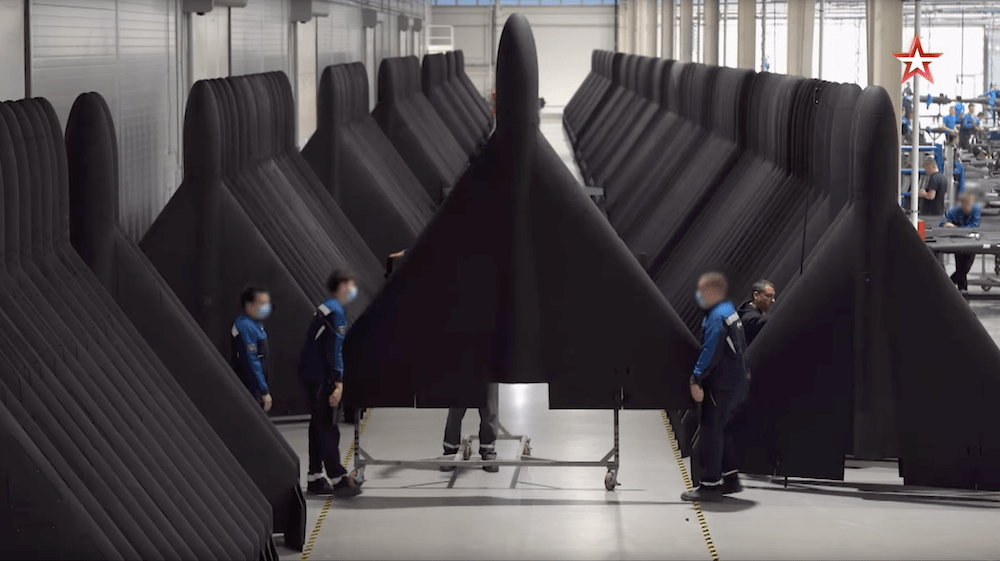
In 2023, the Alabuga SEZ had 80,000 square meters of warehouse space, where 300 workers produced 2,738 Shahed drones in a year.[30][31] By late 2025, Alabuga’s operations had expanded to more than 2.82 million square meters, and its 41,000 workers could output 5,000–6,000 drones per month. Per Ukrainian military leaders, the SEZ planned to surge production to 1,000 per day.[32][33] Due to Russia’s domestic labor shortage, Alabuga relies on low-skill labor from local students and foreign workers, including potentially thousands of North Koreans through an agreement with Pyongyang.[34] As of April 2026, Alabuga SEZ could house roughly 71,000 workers.[35]
To streamline the transportation of critical Shahed components from Chinese suppliers, Russia and China jointly established the Deng Xiaoping Logistics Complex in Alabuga SEZ in September 2024, and they also established an airbridge between Naberezhnye Chelny Begishevo Airport in Tatarstan and China’s Urumqi Airport.[36][37]
This centralized, domestic production model has advantages for Russia—a lower per-unit cost ($70,000 rather than $200,000), increased supply, and less risk of transport spoilage.[38][39] Iran also benefits—Russia shares R&D and performance data about platform modifications, such as navigation systems, anti-jamming technology, and AI computing. Evidence shows Iran used these upgraded drones in its March 2026 strikes on US military bases and other Gulf targets.[40][41]
The rapid expansion at Alabuga combined with the 2023 opening of an additional production line in Izhevsk, Udmurt Republic, suggest Russia will continue to build its domestic OWA drone supply and may look to export Shahed-type drones and hardware.[42][43]
A Model for the Rest of the World
While drone warfare may replace everything from traditional surveillance to fighter aircraft, OWA systems like the Shahed may be its most effective and impactful use case, with implications that reach far beyond today’s battlefields. The Iranian and Russian production models provide a blueprint to states or actors interested in developing proven, resilient, and efficient offensive weapons capabilities.
Given the simplicity of the Shahed-style systems, low-skill labor requirements, and commercially accessible components, it is not difficult to imagine actors replicating these models. Alabuga clearly demonstrates the efficiency of centralized production by a high-capacity state. At the same time, Iran’s decentralized operation illustrates that total elimination is difficult, as evidenced by its ongoing Shahed output despite multiple attacks on its Isfahan production plant.[44][45][46]
Russia is playing an active role in helping its partners manufacture Shahed systems, with China and North Korea likely candidates for future production sites. Russia is reportedly helping China develop its own Shahed clone—the Sunflower 200—and training North Korean workers at Alabuga.[47][48] Iran has also explored setting up foreign factories, potentially in Belarus, according to a 2023 Institute for the Study of War analysis.[49]
Beyond infrastructure, the drone manufacturing machine can become more robust and resilient if future Shahed production deals include intelligence sharing like the Moscow-Tehran agreement for Alabuga. This franchise model supports a unique “proliferation feedback loop,” accelerating technology diffusion and ultimately propelling a global drone arms race.[50][51][52] Its effectiveness also serves as a strong signal to Western manufacturers to accelerate their own Shahed-style clone developments.[53][54]
Sanctions notwithstanding, willing suppliers and potential producers are unlikely to limit the proliferation of Shahed technology and components. Moreover, the allure for actors to expedite production and deployment of thousands of OWA drones is both destabilizing and within the realm of probability.
The risk calculus for Shahed proliferation may change if allies develop low-cost, reliable counter-UAV tactics and enforce export controls on key technology. For now, Chinese replacements for sanctioned technology are frequently less effective than Western hardware; meanwhile, the limiting factor for production at Alabuga is likely hardware (e.g., MD-550 engine).[55][56] Regardless, countering a globalized OWA proliferation threat will require cooperation and learning between allied forces. Ukraine offers examples for how to resist drone-centric campaigns—e.g., deploying swarms of low-cost counter-UAVs rather than expensive missile interceptors, training a dedicated counter-UAV unit, and continuously adapting technology to meet adversary capabilities.[57] These tactics have resulted in fewer Russian drone strikes, with April 2026 logging the Kremlin’s lowest OWA-UAV hit rate into Ukraine in a year.[58]
The Horizon of Drone Warfare
Drones have fundamentally changed modern warfare over the last decade by enabling smaller states and non-state actors to level the playing field and inflict heavy damage against adversaries at low cost. Recent innovations in the Shahed supply chain are bellwethers for the future direction of drone warfare.
The internationally reproducible franchising model for Shahed-136 production combined with drone customizations under development by Russia, China, and North Korea represent a new stage of adversary cooperation and global proliferation. The consequences of this model go beyond global OWA drone inventories. Expanding Shahed production to Russia has led to faster technological innovation, greater intelligence sharing, and an enhanced economic architecture to evade sanctions.
Allied forces need to prepare for a future with more drones. Russia’s battle-tested upgrades to the original Shahed design have spread beyond Ukraine into the Gulf and have the potential to make drone warfare deadlier. Iran’s resilient, decentralized drone supply and Russia’s ambitious output expansion make this point clearer than ever. Each new production line in this chain fortifies the entire system, driving home the urgent need for a comprehensive counter-drone strategy.
References
- Emmett, Joe, Trevor Ball, and N.R. Jenzen-Jones. “Shahed-131 & -136 UAVs: A Visual Guide.” Open Source Munitions Portal. Accessed May 4, 2026. https://osmp.ngo/collection/shahed-131-136-uavs-a-visual-guide/ ↩︎
- Horowitz, Michael C., and Lauren Kahn. “First Ukraine, Now Iran: A New Era of Drone Warfare Takes Hold.” Council on Foreign Relations, March 9, 2026. https://www.cfr.org/articles/the-new-era-of-drone-warfare-takes-root-in-iran ↩︎
- Anokhin, Igor. “Monthly Analysis of Russian Shahed 136 Deployment Against Ukraine: April 2026.” Institute for Science and International Security, May 1, 2026. https://isis-online.org/isis-reports/monthly-analysis-of-russian-shahed-136-deployment-against-ukraine ↩︎
- Bondar, Kateryna. “Unpacking Iran’s Drone Campaign in the Gulf: Early Lessons for Future Drone Warfare.” Center for Strategic and International Studies, March 10, 2026. https://www.csis.org/analysis/unpacking-irans-drone-campaign-gulf-early-lessons-future-drone-warfare ↩︎
- Rubin, Uzi. “Russia’s Iranian-Made UAVs: A Technical Profile.” Royal United Services Institute, January 13, 2023. https://www.rusi.org/explore-our-research/publications/commentary/russias-iranian-made-uavs-technical-profile/ ↩︎
- Tregub, Olena. “Why Striking the Yelabuga and Isfahan Plants Is Just the Start in Crippling the Russia-Iran Drone Empire.” United24 Media, June 17, 2025. https://united24media.com/opinion/why-striking-the-yelabuga-and-isfahan-plants-is-just-the-start-in-crippling-the-russia-iran-drone-empire-9178 ↩︎
- Pashby, Tom. “Countering Iran’s UAS Swarms ‘Requires Compressing the Kill Chain.’” Resilience Media, April 21, 2026. https://resiliencemedia.co/countering-irans-uas-swarms-requires-compressing-the-kill-chain/ ↩︎
- Saxena, Anushka. “China’s Role in Enabling Shahed Drone Supply Lines.” Nikkei Asia, May 7, 2026. https://asia.nikkei.com/opinion/china-s-role-in-enabling-iran-s-shahed-drone-supply-lines ↩︎
- “Why Is the War in Iran So Expensive?” Harvard Kennedy School, April 7, 2026. https://www.hks.harvard.edu/faculty-research/policy-topics/international-relations-security/why-war-iran-so-expensive ↩︎
- MacDonald, Alistair. “Every Nation Wants to Copy Iran’s Deadly Shahed Drone.” Wall Street Journal, September 24, 2025. https://www.wsj.com/world/iran-shahed-drone-copy-development-f8cd8aab ↩︎
- Emmett et al. “Shahed-131 & -136 UAVs: A Visual Guide.” ↩︎
- Albright, David, Igor Anokhin, Sarah Burkhard, Victoria Chang, and Spencer Faragasso. “Alabuga’s Greatly Expanded Production Rate of Shahed 136 Drones.” Institute for Science and International Security, May 10, 2024. https://isis-online.org/isis-reports/alabugas-greatly-expanded-production-rate-of-shahed-136-drones/ ↩︎
- “Military Inspection. Miltech.” Promotional video. Posted July 20, 2025, by Zvezda TV, VK Video, 40 min., 17 sec., https://vk.com/video-220155889_456262163 ↩︎
- “Iran Aircraft Manufacturing Industries (HESA).” Iran Watch. Accessed May 14, 2026. https://www.iranwatch.org/iranian-entities/iran-aircraft-manufacturing-industries-hesa ↩︎
- “Shahed Aviation Industries.” Iran Watch. Accessed May 14, 2026. https://www.iranwatch.org/iranian-entities/shahed-aviation-industries/ ↩︎
- MacDonald, Alistair. “Every Nation Wants to Copy Iran’s Deadly Shahed Drone.” ↩︎
- Vincent, Brandi. “Pentagon Brass Tout Destruction of Iran’s Drone Arsenal, but Questions Linger About What’s Left.” DefenseScoop, April 8, 2026. https://defensescoop.com/2026/04/08/hegseth-gen-caine-iran-drone-arsenal-damage-operation-epic-fury/ ↩︎
- Hendricks, John. “Mapping Iran’s Drone War Infrastructure.” Global Recon, March 6, 2026. https://www.globalrecon.net/analysis/mapping-irans-drone-war ↩︎
- “Drones Like Bicycles.” Phenomenal World, March 11, 2026. https://www.phenomenalworld.org/analysis/cost-of-a-shahed/ ↩︎
- Zampronha, Daniel, and Aline Albuquerque. “Cheaper Precision Weapons: An Exploratory Study about the HESA Shahed 136.” Advances in Aerospace Science and Technology 09, no. 01 (March 2024): 40–59. https://doi.org/10.4236/aast.2024.91004 ↩︎
- “Iran’s Drone Program: How the Islamic Republic Exploited Commercial Supply Chains to Reshape Modern Warfare.” Strider Technologies, March 2026. https://www.striderintel.com/resources/irans-drone-program-how-the-islamic-republic-exploited-commercial-supply-chains-to-reshape-modern-warfare/ ↩︎
- Emmett et al. “Shahed-131 & -136 UAVs: A Visual Guide.” ↩︎
- Shalal, Andrea. “US Imposes Sanctions on Companies It Accuses of Aiding Iran’s Weapons Sector.” Reuters, May 8, 2026. https://www.reuters.com/world/china/us-imposes-sanctions-10-individuals-companies-aiding-irans-weapons-sector-2026-05-08/ ↩︎
- “Economic Fury Disrupts Networks Supplying Weapons and UAV Components to Iran.” US Department of the Treasury, May 8, 2026. https://home.treasury.gov/news/press-releases/sb0496 ↩︎
- Lopez, C. Todd. “Epic Fury Quelled for Now, Objectives Accomplished, US Forces Remain Ready.” U.S. Department of War, April 8, 2026. https://www.war.gov/News/News-Stories/Article/Article/4454276/epic-fury-quelled-for-now-objectives-accomplished-us-forces-remain-ready/ ↩︎
- Cohen, Zachary, and Natasha Bertrand. “Iran Rebuilding Military Industrial Base Faster than Expected, Already Producing Drones, According to US Intel.” CNN, May 21, 2026. https://www.cnn.com/2026/05/21/politics/iran-military-rebuild ↩︎
- Shadi, Mohamed and Mostafa Ahmed. Al Habtoor Research Centre. “The Missile and Drone Dilemma: When Defensive Measures Outstrip the Cost of Attack.” March 5, 2026. https://www.habtoorresearch.com/programmes/the-missile-and-drone-dilemma-when-defensive-measures-outstrip-the-cost-of-attack/ ↩︎
- Al-Ghusbi, Omar, and Conrad Rousseau. “Airborne Axis: Inside the Deal that Brought Iranian Drone Production to Russia.” C4ADS, May 29, 2025. https://c4ads.org/reports/airborne-axis/ ↩︎
- Albright et al., “Alabuga’s Greatly Expanded Production Rate of Shahed 136 Drones.” ↩︎
- Sebastian, Clare, Vasco Cotovio, Allegra Goodwin, Victoria Butenko, and Darya Tarasova-Markina. “Russia Is Intensifying Its Air War in Ukraine. A Secretive Factory Is Ramping Up Drone Production to Fuel the Offensive.” CNN, December 27, 2024. https://edition.cnn.com/2024/12/27/europe/russia-ukraine-war-drones-alabuga-factory-intl-invs ↩︎
- Bint, Matthew, and Fabian Hinz. “Russia Doubles Down on the Shahed.” International Institute for Strategic Studies, April 14, 2025. https://www.iiss.org/online-analysis/military-balance/2025/04/russia-doubles-down-on-the-shahed/ ↩︎
- Moore, Johanna. “Adversary Entente Cooperation at Russia’s Shahed Factory Threatens Global Security.” Institute for the Study of War, November 21, 2025. https://understandingwar.org/research/adversary-entente/adversary-entente-cooperation-at-russias-shahed-factory-threatens-global-security/ ↩︎
- Loh, Matthew. “Russia Is Pushing To Build 1,000 of Its Localized Iranian Shahed Drones Every Day, Ukraine’s Military Chief Says.” Business Insider, January 19, 2026. https://www.businessinsider.com/ukraine-oleksandr-syrskyi-russia-1000-shahed-per-day-2026-1 ↩︎
- Albright, David, Spencer Faragasso, and the Good ISIS Team. “Major Developments at Alabuga SEZ Point to Significant Expansion in Military Drone Production.” Institute for Science and International Security, July 28, 2025. https://isis-online.org/isis-reports/detail/major-developments-at-alabuga-sez-point-to-significant-expansion-in-military-drone-production/ ↩︎
- “Alabuga, the Central Hub of the Russian Hybrid Threat.” All Eyes on Wagner, April 19, 2026. https://alleyesonwagner.org/2026/04/19/alabuga-the-central-hub-of-the-russian-hybrid-threat/ ↩︎
- “Alabuga, the Central Hub of the Russian Hybrid Threat.” ↩︎
- Moore, “Adversary Entente Cooperation at Russia’s Shahed Factory Threatens Global Security.” ↩︎
- Moore, “Adversary Entente Cooperation at Russia’s Shahed Factory Threatens Global Security.” ↩︎
- Bennett, Dalton, and Mary Ilyushina. “Inside the Russian Effort to Build 6,000 Attack Drones with Iran’s Help.” Washington Post, August 17, 2023. https://www.washingtonpost.com/investigations/2023/08/17/russia-iran-drone-shahed-alabuga/ ↩︎
- Burrows, Emma. “Russia Is Sending Upgraded Drones Used in the Ukraine War to Iran, Officials Say.” Associated Press, March 27, 2026. https://apnews.com/article/russia-iran-drones-shahed-war-israel-ukraine-840b4f885d99714bdb7813c0d56213cf ↩︎
- Khomenko, Ivan. “Iran’s Shahed Drone That Hit UK Base Includes Russian Kometa-M Technology.” United24 Media, March 3, 2026. https://united24media.com/latest-news/irans-shahed-drone-that-hit-uk-base-includes-russian-kometa-m-technology-16429 ↩︎
- Deutsch, Anthony, and Tom Balmforth. “Exclusive: Russia Produces Kamikaze Drone With Chinese Engine.” Reuters, September 13, 2024. https://www.reuters.com/world/europe/russia-produces-new-kamikaze-drone-with-chinese-engine-say-european-intel-2024-09-13/ ↩︎
- Albright et al., “Alabuga’s Greatly Expanded Production Rate of Shahed 136 Drones.” ↩︎
- Bergman, Ronen, David E. Sanger, and Farnaz Fassihi. “Israel Launched Drone Attack on Iranian Facility, Officials Say.” New York Times, January 29, 2023. https://www.nytimes.com/2023/01/29/world/middleeast/iran-drone-strike-israel.html ↩︎
- U.S. Central Command (@CENTCOM), “The Esfahan Khomeynishahr Drone Production Plant produced Shahed one-way attack drones that have been used by the Iranian regime to attack targets across the region. The photo dated March 3, 2026, shows the plant before U.S. strikes. […]” X, March 20, 2026, https://x.com/CENTCOM/status/2035074369014174009 ↩︎
- Kulish, Nicholas. “In Iran War, Cheap Drones Remain Wild Card.” New York Times, March 25, 2026. https://www.nytimes.com/2026/03/25/world/middleeast/iran-war-cheap-drones.html ↩︎
- Moore, “Adversary Entente Cooperation at Russia’s Shahed Factory Threatens Global Security.” ↩︎
- Nardelli, Alberto, Jennifer Jacobs, and Alex Wickham. “US Allies Say China Is Developing Attack Drones for Russia.” Bloomberg, July 2, 2024. https://www.bloomberg.com/news/articles/2024-07-02/china-is-building-and-testing-lethal-attack-drones-for-russia ↩︎
- Ganzeveld, Annika, Amin Soltani, and Andie Parry. “Iran Update, August 1, 2023.” Institute for the Study of War, August 2, 2023. https://www.understandingwar.org/backgrounder/iran-update-august-1-2023 ↩︎
- Khachatryan, Davit. “Beyond the Drone Hype: Unpacking Nagorno-Karabakh’s Real Lessons.” EVN Report, March 27, 2024. https://evnreport.com/politics/beyond-the-drone-hype-unpacking-nagorno-karabakhs-real-lessons/ ↩︎
- Saxena, Anushka. “Building a Drone Like Producing Nutella.” Eye on China, April 20, 2026. https://eyeonchina.substack.com/p/building-a-drone-like-producing-nutella ↩︎
- “Iran War: Weapon Programs One-Month Update.” Iran Watch, March 31, 2026. https://www.iranwatch.org/our-publications/articles-reports/iran-war-weapon-programs-one-month-update/ ↩︎
- MacDonald, “Every Nation Wants to Copy Iran’s Deadly Shahed Drone.” ↩︎
- Simkins, J.D. “US Confirms First Combat Use of LUCAS One-Way Attack Drone in Iran Strikes.” Military Times, February 28, 2026. https://www.militarytimes.com/news/your-military/2026/02/28/us-confirms-first-combat-use-of-lucas-one-way-attack-drone-in-iran-strikes/ ↩︎
- Anokhin, “Monthly Analysis of Russian Shahed 136 Deployment Against Ukraine: April 2026.” ↩︎
- Chin, Josh, and Austin Ramzy. “China Is Still Supplying Drone Factories in Iran, Russia Despite U.S. Sanctions.” Wall Street Journal, May 5, 2026. https://www.wsj.com/world/china-is-still-supplying-drone-factories-in-iran-russia-despite-u-s-sanctions-1e6820ca ↩︎
- Bondar, “Unpacking Iran’s Drone Campaign in the Gulf.” ↩︎
- Anokhin, “Monthly Analysis of Russian Shahed 136 Deployment Against Ukraine: April 2026.” ↩︎